Thursday, July 7, 2011
Universal Design India Principles © 2011
A group of industrial designers, architects, ergonomists and access consultant from prestigious academic institutions and a few proactive NGOs in India, collectively made a humble attempt to formulate ‘Five Universal Design India Principles’ with strong Indian idiom to design inclusive products, environments and systems. Dedicated to its one-third of the total world’s disabled population, second largest elderly population, and contradictions of large poor population living in second fastest growing economy, these five Universal Design India Principles intend to build consensus on contextual definition and principles of practice to address the needs of its diverse population.
© 2011 National Institute of Design, Ahmedabad
Co-Authors (In alphabetical order):
Abir Mullick, National Institute of Design, Ahmedabad
Anjlee Agarwal, Samarthyam, New Delhi
Balaram S., D J Acdemy of Design, Coimbatore
Debkumar Chakrabarti, Indian Institute of Technology, Guwahati
Gaurav Raheja, Indian Institute of Technology, Roorkee
Haimanti Banerjee, Indian Institute of Technology, Kharagpur
Rachna Khare, School of Planning and Architecture, Bhopal
Ravi Shankar, National Institute of Design, Bangalore
Wednesday, April 6, 2011
UNIVERSAL DESIGN WORKSHOP, 3RD, 4TH & 5TH MARCH 2011- PROGRAM - OVERVIEW
PROGRAM - OVERVIEW
UNIVERSAL DESIGN WORKSHOP, 3RD, 4TH & 5TH MARCH 2011
The three day Universal Design Workshop has been planned as a culmination of a National Student Design Competition for Design for All/Universal Design that was floated in Oct’2010 by SPA-Bhopal. The institute received tremendous response for this competition from architecture and design schools with about eighty registrations and thirty design entrees. The registered student teams prepared their designs based on the design brief and in consultation with their faculty advisors. The teams were also provided with a list of books, websites and other online resources on universal design to make their challenge an informed attempt. The final evaluation of this competition was coupled with a three days workshop on 3rd, 4th & 5th March 2011. The two best competition entries were awarded and all shortlisted entries were displayed as an exhibition for the professionals for wider dissemination. The workshop was convened by Dr. Rachna Khare and coordinated by Ar. Sandeep Sankat and Ar. Ram Sateesh Pasupuleti.
WORKSHOP OBJECTIVES• Create awareness about ‘Universal Design’ amongst budding architects, planners and design professionals to support social sustainability
• Provide hands-on experience to understand practical application of Universal Design to design Inclusive built-environment for everyone including people with functional limitations.
• Learn about Universal Design education, teaching and practice
• Develop example of a model building through intense Universal Design Education
DAY ONE- 3rd March 2011
Workshop participants registered from various corners of the country to participate in the 3 day Universal Design Workshop organised by Center for Human centric Research, School of Planning and Architecture, Bhopal. The workshop started with SPA anthem honoured with the presence of Chief-guest Padmabhushan Shree M.N.Buch and Special Guest Dr. Deepankar Banerjee, State Disability Commissioner, Madhya Pradesh. Prof. Ajay Khare, Director School of Planning and Architecture, Bhopal, Professor Abir Mullick, Georgia Institute of Technology Atlanta USA, Dr.Gaurav Raheja from IIT Roorkee, Mr. Pankaj Bajpayee from National Institute of Orthopedically Handicapped, Architect Abhishek Ray and Rohini Rama Krishnan from DRDF were also present on the occasion.
Inaugural Ceremony - Convener Rachna Khare, Special Guest Dr. Deepankar Banerjee, Chief Guest Padmabhushan Shree M.N.Buch, Prof. Ajay Khare, Director, SPA-Bhopal, Professor Abir Mullick (sequentially on podium).
Exhibition: National Student Design Competition for Design for All/Universal Design
The Exhibition of the shortlisted entries of National Student Design Competition had also been inaugurated by the honourable chief guest. Concluding inaugural session Padma Bhushan Shree M.N.Buch and Dr.Deepankar Benarjee briefly expressed their views and visions on the issues and concerns related to Universal Design. After inaugural session Professor Abir Mullick, an eminent expert of Universal Design from Georgia Institute of Technology, Atlanta, USA delivered keynote address on “Universal Design in Design Teaching / Studio”. Prof. Mullick is a strong supporter of universal design and is internationally known for inclusive designs that deal with social justice, personal empowerment and collective equity. He is one of the authors of the seven principles of universal design.He shared his experience as a teacher, scholar, researcher and designer in his presentation.
Post lunch, expert teams carried out five parallel sessions on Interactive hands-on exercises with the participants, ‘Observation/Analysis/Design’ by Prof. Abir Mullick, ‘Dialogues in the dark’ by Mr. Ahishek Ray and Ms. Rohini Ramkrishnan, ‘Disability in Indian Cinema’ by Mr. Ahishek Ray and Ms. Rohini, ‘Batein-An interactive session with an attempt to understand users’ by Mr. Anil Mudgil, Dr. Rohit Trivedi, Ms Sufia Khan and ‘Simulating Spatial Experiences’ by Prof. Gaurav Raheja. At the end of the day, ‘Khosish’ a movie related to the workshop theme was shown to the participants and the first day workshop program ended with an online interaction with the filmmaker Gulzar.
DAY TWO- 4th March 2011
On the day two of the workshop all the shortlisted teams of National Student Design Competition for Design for All/Universal Design that was floated in Oct’2010 by SPA-Bhopal presented their work in front of the jury members in an open session. The judging panel consists of some strong proponents of universal design and a team representing stake-holders. Following experts of Universal Design in the country and stake-holders were invited to judge the competition.
• Prof. Abir Mullick, Georgia Institute of Technology, Atlanta, USA
• Dr. Ratnesh Kumar, National Institute of Orthopaedically Handicapped, Kolkata
• Dr. Pankaj Bajpai, National Institute of Orthopaedically Handicapped, Kolkata, India
• Dr. Rachna Khare, School of Planning and Architecture, Bhopal, India
• Dr. Gaurav Raheja, Department of Architecture and Planning, IIT, Roorkee, India
• Architect Abhishek Ray, Disability Design and Research Foundation, Mumbai, India
Interactive hands-on exercises related to Universal Design by experts
National Student Design Competition- Presentations before Jury
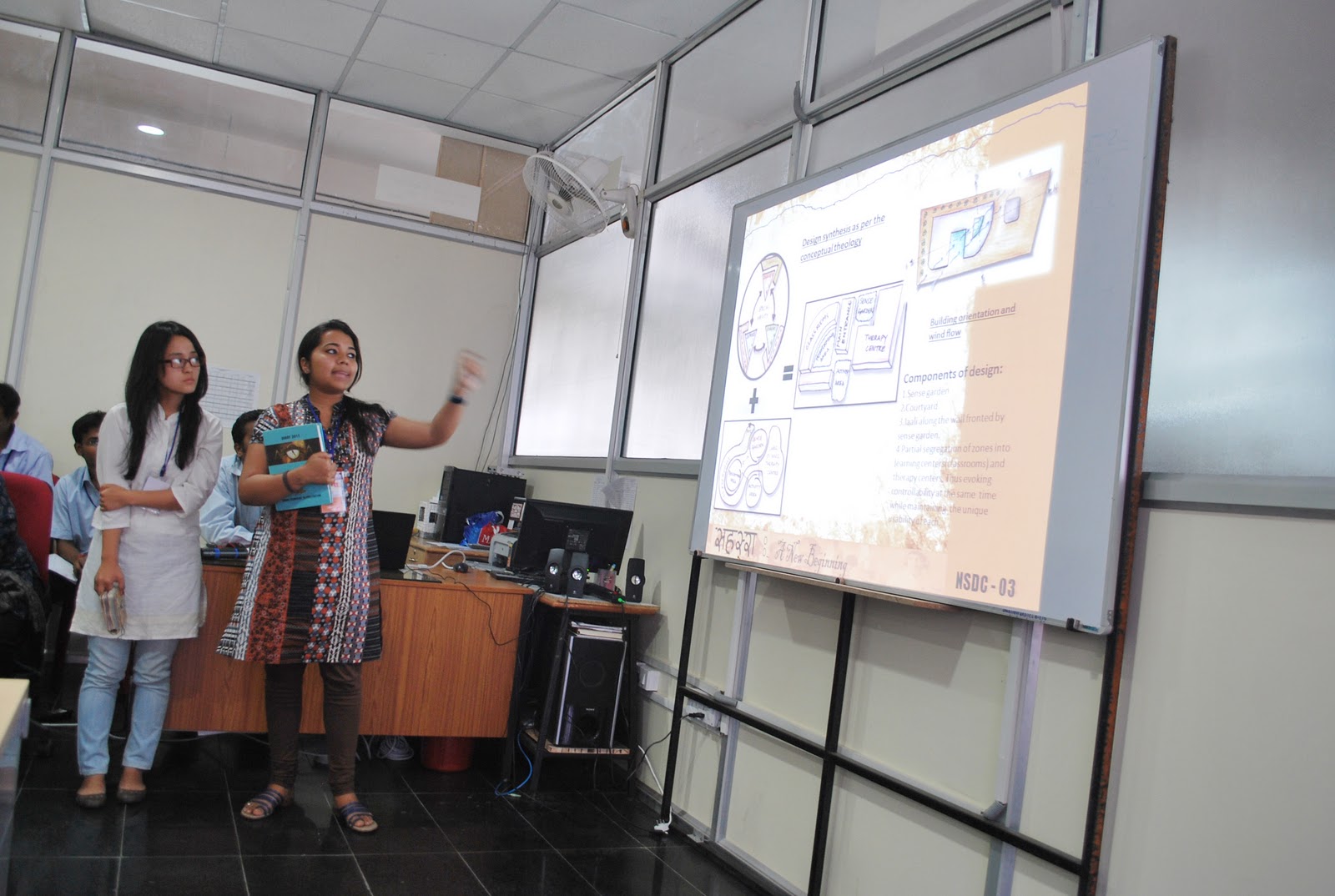
All the eighteen shortlisted teams sequentially presented their work throughout the day, and it was mesmerizing to see the creative ideas and thoughts from the budding built environment professionals. In the evening a cultural program was conducted by SPA Bhopal along with some volunteers from Aarushi.
DAY THREE- 5th March 2011
On the morning of day three, architect Abhishek Ray made a presentation on the topic ‘Universal Design in Design Practice’. Architect Abhishek Ray is using emerging genre Universal Design in the professional arena to engage with builders, architects, city planners and citizen organizations to create inclusive and user-friendly environments that serve not only the special needs of the disabled but take into account the diverse needs of the general population. In his presentation he shared his views on the subject.
In the next session Dr. Gaurav Raheja presented his views on ‘Universal Design in Indian Context’. Gaurav Raheja Ph.D. from IIT Roorkee in Universal Design Research, he is a member of many important committees on accessibility in the country and is Mphasis Universal Design Award holder in 2010. He shared his knowledge of working with rural Indian population in his presentation.
Before the Valedictory Session, experts and participants had invigorating session in which they shared their understanding and provided their feedback on workshop. This session was coordinated by Dr. Rachna Khare. She is a Fulbright Scholar and a strong supporter of Inclusive Design and coordinating the Center for Human centric Research (CHCR) at School of Planning and Architecture, Bhopal, India. Prior to this she was Fellow, Jamsetji Tata Universal Design Research Chair at National Institute of Design, Ahmedabad.
The Results of the Student Competition was declared in this concluding Valedictory Session and the Certificate of Participants was presented by the experts. First five entries were acknowledged and first and second prize of Rs. 50,000 and Rs. 25,000 was awarded to the winners. The first position was bagged by Bhanuben Nanavati College of Architecture, Pune and School of Planning and Architecture, Bhopal won second position. The program ended with a vote of thanks by the coordinating team from SPA-Bhopal, Dr. Rachna Khare, Ar. Sandeep Sankat and Ar. Ram Sateesh Pasupuleti.
Friday, January 14, 2011
UPCOMING THREE DAY UNIVERSAL DESIGN WORKSHOP ON 3rd, 4th & 5th MARCH 2011
NATIONAL STUDENT DESIGN COMPETITION ON DESIGN FOR ALL / UNIVERSAL DESIGN
CULMINATING WITH
A THREE DAYS WORKSHOP
THAT WILL SHAPE WHAT YOU THINK, CREATE AND BUILD
AT
SCHOOL OF PLANNING AND ARCHITECTURE, BHOPAL
We at SPA-Bhopal are glad to receive an overwhelming response for the ‘National Student Design Competition on Design for All / Universal Design’ with seventy six registrations representing thirty colleges around the country. The registered student teams will now start their work based on the design brief in consultation with their faculty advisors, and will submit their work by 15th February 2011. Considering large number of entries evaluation will be done in two stages, 1st stage short listing will be done by a team of experts to select 10-12 entries. The 2nd stage final evaluation of the short-listed entries will be done through presentation by representative members of the team to select two winners. Final evaluation will be coupled with a three days workshop on 3rd, 4th & 5th March 2011, with world-known Universal Design Experts. The three days of the Universal Design workshop will give a unique experience through intense interaction and hands-on experiences and will help develop an insight to what designers think, create and build.
National Student Competition at SPA-Bhopal was launched on it's Foundation Day by Prof Abir Mullick from Georgia-Tech, USA. Prof. Mullick is a strong proponent of Universal Design and one of the authors of Seven Universal Design Principles. He also lectured on 'Universal Design Perspective to Address Social Inequalities and Promote Democratic and Community Living'
Prof E.F.N. Rebeiro, an Eminent Urban Planner, Chairman BOG, SPA-Bhopal and former Director SPA-Delhi, lectured on 'Emerging Integrated Frameworks for the Built Environment in India'
Few more glimpses of foundation day, Director, SPA-Bhopal Prof.Ajay Khare, presenting overview of the institute and cultural function
Wednesday, January 12, 2011
National Centre for Universal Design and Barrier-Free Environment (NCUDBE)
Task Force set up to work out details for setting up of National Centre for Universal Design and Barrier-Free Environment (NCUDBE)
Delhi , October 29,2010 13:39 IST
Source: Press Information Bureau, Mumbai India
http://pibmumbai.gov.in/scripts/detail.asp?releaseId=E2010PR1958
The Centre has constituted a Task Force to work out the details for establishment of the proposed National Centre for Universal Design and Barrier-free Environment (NCUDBE) which was envisaged in the Eleventh Five Year Plan as a national body to facilitate and support the development of universal design and barrier-free environment.
The Task Force, set up by the Ministry of Social Justice & Empowerment, has been mandated to examine in detail the need for setting up of NCUDBE, its structure, possible role and functions, its scope in the R&D in the area of assistive technology, implementation modalities and its manpower and financial requirement etc.
The Task Force will also give its recommendations on the extent to which it should do R&D in house and support R&D efforts by other agencies. It will also dwell upon the issue of the National Centre’s structure that whether it should be set up as an independent entity or under the umbrella of a suitable existing institution like the National Institute of Design or the Council of Scientific and Industrial Research (CSIR).
The Task Force is headed by Prof. Samir K. Brahmachari, Director General of the Council of Scientific and Industrial Research and will have members from the National Institution of Design, Ahemdabad and School of Planning & Architecture, New Delhi. The Task Force will also have nominees (one each) from the Central Government’s Departments of Telecommunication and Information Technology. The Joint Secretary in charge of the Disability Division in Ministry of Social Justice will be the Convenor and Ex-Officio Member and Director of Deendayal Uppadhaya Institute for the Physically Handicapped, New Delhi will be the Member-Secretary of the Task Force.
Besides the Plan Document, the establishment of such a Centre is also obligatory under the UN Convention on the Rights of Persons with Disabilities to which India is a signatory. Article 2 of the Convention describes “Universal Design” as the design of products, environments, programmes and services to be usable by all people, to the greatest extent possible, without the need for adaptation or specialized design. Article 4 of the UN Charter lists it as general obligation to undertake or promote research and development of universally designed goods, services, equipment and facilities which should require the minimum possible adaptation and the least cost to meet the specific needs of a person with disabilities, to promote their availability and use, and to promote universal design in the development of standards and guideline.
It may be recalled that last month, the Ministry of Social Justice and Empowerment had invited proposals from the States for central assistance to provide barrier free environment in public buildings including State Secretariat, Collectorates, Main Hospitals, Universities and other important State level offices to ensure that these are accessible to the People with Disabilities. The proposals have been invited after making significant increase in the annual budget of the Scheme for Implementation of PwD Act from Rs. 15-20 crore annually to Rs. 100 crore for the year 2010-11. The central assistance will also be given to make the Government Websites at the State and District levels accessible to PwDs.
Delhi , October 29,2010 13:39 IST
Source: Press Information Bureau, Mumbai India
http://pibmumbai.gov.in/scripts/detail.asp?releaseId=E2010PR1958
The Centre has constituted a Task Force to work out the details for establishment of the proposed National Centre for Universal Design and Barrier-free Environment (NCUDBE) which was envisaged in the Eleventh Five Year Plan as a national body to facilitate and support the development of universal design and barrier-free environment.
The Task Force, set up by the Ministry of Social Justice & Empowerment, has been mandated to examine in detail the need for setting up of NCUDBE, its structure, possible role and functions, its scope in the R&D in the area of assistive technology, implementation modalities and its manpower and financial requirement etc.
The Task Force will also give its recommendations on the extent to which it should do R&D in house and support R&D efforts by other agencies. It will also dwell upon the issue of the National Centre’s structure that whether it should be set up as an independent entity or under the umbrella of a suitable existing institution like the National Institute of Design or the Council of Scientific and Industrial Research (CSIR).
The Task Force is headed by Prof. Samir K. Brahmachari, Director General of the Council of Scientific and Industrial Research and will have members from the National Institution of Design, Ahemdabad and School of Planning & Architecture, New Delhi. The Task Force will also have nominees (one each) from the Central Government’s Departments of Telecommunication and Information Technology. The Joint Secretary in charge of the Disability Division in Ministry of Social Justice will be the Convenor and Ex-Officio Member and Director of Deendayal Uppadhaya Institute for the Physically Handicapped, New Delhi will be the Member-Secretary of the Task Force.
Besides the Plan Document, the establishment of such a Centre is also obligatory under the UN Convention on the Rights of Persons with Disabilities to which India is a signatory. Article 2 of the Convention describes “Universal Design” as the design of products, environments, programmes and services to be usable by all people, to the greatest extent possible, without the need for adaptation or specialized design. Article 4 of the UN Charter lists it as general obligation to undertake or promote research and development of universally designed goods, services, equipment and facilities which should require the minimum possible adaptation and the least cost to meet the specific needs of a person with disabilities, to promote their availability and use, and to promote universal design in the development of standards and guideline.
It may be recalled that last month, the Ministry of Social Justice and Empowerment had invited proposals from the States for central assistance to provide barrier free environment in public buildings including State Secretariat, Collectorates, Main Hospitals, Universities and other important State level offices to ensure that these are accessible to the People with Disabilities. The proposals have been invited after making significant increase in the annual budget of the Scheme for Implementation of PwD Act from Rs. 15-20 crore annually to Rs. 100 crore for the year 2010-11. The central assistance will also be given to make the Government Websites at the State and District levels accessible to PwDs.
Monday, December 6, 2010
Universal Design Symposium and Book Release at Boston
'Designing Inclusive Educational Spaces for Children with Autism' authored by Rachna Khare, published by Institute of Human Centered Design, USA, released on 18th November 2010 during 'Build Boston'
Sunday, December 5, 2010
Thursday, November 25, 2010
REPORT SUBMITTED TO NID- Ahmedabad, WHEN LEAVING FOR SPA-Bhopal
THE JAMSETJI TATA UNIVERSAL DESIGN RESEARCH CHAIR
STATUS REPORT JUNE’ 2010
by Rachna Khare (prepared when leaving NID in June 2010)
NID in collaboration with Dorabji Tata Trust, Mumbai, has constituted the ‘Jamsetji Tata Trust Chair for Universal Design at NID’. The instituted objective of the Chair is to address developmental gaps/requirements of the society for collective socio-economic-cultural development of the country. Ms Rachna Khare, Senior Research Fellow, Joined on 14th October, 2009 and commenced the Fellowship activities from Bhopal.
The work started with a goal to address the above objective, by preparation of an annual plan with a three year plan-projection, in consultation with experts working in the area of Universal Design. The plan intend to increase the Universal Design concentration at undergraduate, post graduate and faculty research level at NID first and then gradually take it to a larger scale, at national and international level.
Flow Chart: Universal Design Initiatives under Jamsetji Tata-NID Design Research Chair
Initial efforts concentrated on developing an overall understanding of the objects of the chair, projecting future picture and linking it with existing structure at NID. The two major areas under which the work progressed are:
I. Design Research Activity thru’ Universal Design Research Project
II. Other Activities to support Universal Design at NID
I. Design Research Activity:
To support design research activity a Universal Design Research Project is taken up by the Senior Research Fellow on ‘Universal Design Solutions for Pupils with Cognitive Disabilities in India’. The project is expected to generate interest amongst existing faculties and students, finally resulting in more projects in the area of Universal design.
This design research project proposal stands on the author’s experiences of children with brain based limitations and their unusual sense of space perception. The main purpose of this research study is to determine the enabling aspects of educational environments, for successful inclusive learning environment. The principal objectives are:
• Explore potential of design for children with cognitive disabilities and identify enabling features for them in educational spaces
• Develop simple universal design guidelines to help pupils with cognitive limitations, using space defining elements as teaching-learning instruments.
The study is based on her earlier research sponsored by AICTE-India and Fulbright Fellowship Program-USA, to define enabling learning environment for complex conditions in autism as lowest common disorder. Under Jamsetji Tata- NID design research fellowship, this research is extended to include children with other cognitive limitations as well and the data is projected to the Indian backdrop. A sixth step is added this five step study for this purpose and the identified Design Parameters are to be tested on children with all brain based limitations using earlier developed tools. Most of work in the previous study was conducted in USA, but during this stage of research data will be collected in India to understand cross cultural validity of identified Design issues.
Most of the early researches on educational space design for cognitive disabilities are limited to the segregated educational setups for children; With growing drive towards full inclusion in the world after Salamanca Statement (UNESCO 1994) , the present research becomes extremely relevant in providing suitable environment to children with cognitive limitations in inclusive settings. Moreover in India, where the Census 2001 reports that 1.67% of the total population in the age-group 0-19 years (7 million) are living with disabilities, out of which 23.02% have cognitive disabilities and only 1% of those have access to education , the target of Sarva Shikha Abhiyan (SSA) would never be achieved without including them. The present research emphasizes the absolute need for a fresh approach in designing educational spaces for a supportive, accessible and integrated universal environment, where the whole building indoors and outdoors is treated as a large teaching instrument. The study is expected to catch attention of multidisciplinary team of researchers and has direct application in the field for all stake holders. The developed enabling environmental aspects may prove valuable to the researches in the field of brain based limitations, design, education and environmental-behavior research. The design guidelines are expected to provide a framework that may be used by designers, architects, teachers, educators, experts, school administrators and all those who wish to provide a successful environment for children with cognitive limitations.
The Senior Research Fellow is working with organizations working with children with cognitive limitations for data collection and survey. She has obtained permission from following organizations to carry out survey for her study
• Composite Rehabilitation Center: Ministry of Social Justice and Empowerment
• SNAC Center, National Trust, Ahmedabad: BPA
• SNAC Center, National Trust, Bhopal: Digadarshika
Following publications and presentations are done by the Senior Research Fellow, at national and international level from October-May’ 2010, regarding her work.
1. ‘Incorporating Dimension of Behavior in Inclusive Learning Environment Design for autism’ published in International Journal for Architectural Research (IJAR), Vol.3 Issue 3, November 2009, published by Archnet- Massachusetts Institute of Technology, USA
2. Universally Beneficial Educational Space Design for Children with Autism; the Research Progression’ presented in the international conference ‘Designing for Children’ with focus on 'Play + Learn', hosted by the Industrial Design Centre (IDC), at the Indian Institute of Technology (IIT) Bombay, India in February 2010.
3. ‘Universal Design Solutions for Pupils with Cognitive Disabilities in India’ accepted for publication in Trellis, Issue March’ 2010, published by National Institute of Design, Ahmedabad, India
4. ‘Using Evidence based Research Method to Design Inclusive Learning Environment for Autism’, accepted for publication as a Book Chapter scheduled for July, 2010 by CRC Press of Taylor & Francis, Ltd. London, UK
5. ‘Designing Inclusive Educational Spaces for Children with Autism’ (My doctoral dissertation completed in 2009), accepted for publication as a Book by Institute of Human Centered Design (IHCD), Boston, USA, scheduled to be released in November' 2010.
II. Other Activities to support Universal design at NID: The other activities that are supported by the chair are
A. Formation of Universal Design Resource Group:
To support Universal Design Initiatives under Jamsetji Tata-NID Universal Design Research chair, the objectives and proposals are discussed with different faculty members at NID. These interactions finally led to the formation of a Core-Group for Universal Design Initiatives. The Core-Group consists of the faculty members from all three campuses of NID Paldi, Gandhinagar, Bangalore, and visiting professors from Germany. Apart from the core-group a larger group of interested faculty and students at NID is also formed through a group mail. A blog http://universaldesigninindia.blogspot.com/ is developed to provide a virtual interactive platform that may act as groundwork to a web resource for Universal Design.
B. Infusing Universal Design in regular design curriculum:
Universal Design is not a specialized approach but an orientation to any design process that starts with a responsibility to include people from all levels of the pyramid in design. Apart from the specialized programmes in Universal design, Universal design approach should be infused in regular design curriculum at all levels. The experts feel that it should be included in regular design teaching as a holistic thinking tool that adds value to existing design process. The Senior Research Fellow in consultation with other faculty members and students explored the possibilities to infuse Universal Design thinking in regular design education. With present curriculum of NID four possibilities emerged in the first phase of discussion, and supporting efforts are carried out under Jamsetji Tata-NID chair. These four possibilities are
• Open Elective on Universal Design for 2nd year of the Graduate Diploma Programme in Design (GDPD) and the 1st year of the Post Graduate Diploma Programme (PGDPD)
• Introduce a three day short module on Universal Design for students at Design Foundation level, in undergraduate and postgraduate programmes at NID.
• Include Universal Design aspects in existing elective course on Design for Special Needs (DFSN) in Product Design and Furniture & Interior Design Disciplines.
• Sponsoring Student Diploma Projects
With this year theme of Open Elective–‘Responsibly Designed for India’ a ten day Open Elective on Universal Design was floated for design students on ‘Universal Design for Social Sustenance’ in January’ (11th-22nd) 2010 with the support of local NGO’s Unnati and Blind People Association. Though it could not be conducted due to low student registration but it was successful in spreading considerable awareness for ‘Universal Design’ in the NID community.
Relating to the objectives of the chair, guidelines to select student diploma projects at NID on Universal Design for sponsorship are prepared under Jamseji Tata Design research chair. Based on the guidelines, projects are evaluated for sponsorship. Two student projects are sponsored in 2009 and six diploma project proposals are received in 2010 short listing of those is in-progress.
Efforts are also in-progress relating to short module on Universal Design for students at Design Foundation level and elective course on Design for Special Needs
C. Post Graduate Programme in ‘Universal Design Thinking’
To support Universal Design Initiatives, the Senior Research Fellow, Jamsetji Tata Chair is involved in an effort to explore the possibilities to begin a Post-graduate programme in ‘Universal Design Thinking’ at NID at Bangalore Campus. This is done together with experts from University of Applied science and Arts, Hanover and University of Applied Science and Arts , Berlin. The concept proposal was prepared after intense discussions with Mr Ravi Shankar (NID-B’lore campus), Ms Marie Kuprat , Ms Katharina Kraemer and Prof. Birgit Weller from University of Applied Sciences and Arts and presented to the director on 7th April 2010. Incorporating his suggestions, the final proposal is under preparation with finer details. The 2 year PG program is proposed to start in November 2011.
Proposal for Competence Centre for Universal Design at NID is also being initiated at NID. This Center may be formed to co-ordinate the activities related with Universal Design in the long run. This core-group may have representatives of all design streams and would help the students to internalize the concept to produce more responsible designs. The center may organize student activities, workshops, exhibitions, publications, conferences, teach courses, guide senior students and may also take up research and design projects related with Universal Design.
D. In-house publication:
It is being observed during core group interactions that there are many past projects of student and faculties focusing on functional limitations. Under Jamsetji tata Universal Design Research Initiatives, efforts are done to map such past projects for publication. This is expected to generate a resource that will not only benefit a larger population but will also create a link between past and present efforts at NID. The resultant publication will also generate a pool of case-studies for the proposed PG programme at NID. The process of identifying such past projects and process of short listing has already started and the projects shorlisting is done under the subthemes of ‘Assistive Design’, ‘Adaptive Design’, ‘Life Span Design’, ‘Designing for Genders’ and ‘Designing for Special Needs and other disadvantaged groups’.
E. National Event:
‘Universal design’ philosophy though comes from the west, is deeply rooted in the Indian tradition. Today this spirit is lost in the process of industrialization making life difficult and complex for everyone, not to mention the elderly and the people with disabilities. Indians are not only more in number than most of the western countries but are also much diverse, socially, culturally and economically. Today there is a need to introspect and discover an approach for Universal Design that is contextually more appropriate. Three Successive Round Table Deliberations are proposed under Jamsetji tata Universal Design Research Initiatives in the year 2010-2011 (golden jubilee year of NID) on ‘Universal Design in India - a holistic approach for socially responsible design’. The main objective would be to discuss issues concerning ‘Universal Design thinking’ in the design education and design practice in the country. These round tables are proposed to be held in three different regional zones in the country, with an aim to establish universal Design in right Indian context. The Participants may include representatives from the field of design education (Deans or Principals + Faculty members in charge of the academic programs from design + others working in the field of accessibility or universal design), representatives from the industry.
Report by Rachna Khare, Senior Research Fellow,
Jamsetji Tata-NID Design Research Chair
National Institute of Design, Paldi, Ahmedabad
Phone: +91-9425010389,
E-mail: khare_rachna@hotmail.com
STATUS REPORT JUNE’ 2010
by Rachna Khare (prepared when leaving NID in June 2010)
NID in collaboration with Dorabji Tata Trust, Mumbai, has constituted the ‘Jamsetji Tata Trust Chair for Universal Design at NID’. The instituted objective of the Chair is to address developmental gaps/requirements of the society for collective socio-economic-cultural development of the country. Ms Rachna Khare, Senior Research Fellow, Joined on 14th October, 2009 and commenced the Fellowship activities from Bhopal.
The work started with a goal to address the above objective, by preparation of an annual plan with a three year plan-projection, in consultation with experts working in the area of Universal Design. The plan intend to increase the Universal Design concentration at undergraduate, post graduate and faculty research level at NID first and then gradually take it to a larger scale, at national and international level.
Flow Chart: Universal Design Initiatives under Jamsetji Tata-NID Design Research Chair
Initial efforts concentrated on developing an overall understanding of the objects of the chair, projecting future picture and linking it with existing structure at NID. The two major areas under which the work progressed are:
I. Design Research Activity thru’ Universal Design Research Project
II. Other Activities to support Universal Design at NID
I. Design Research Activity:
To support design research activity a Universal Design Research Project is taken up by the Senior Research Fellow on ‘Universal Design Solutions for Pupils with Cognitive Disabilities in India’. The project is expected to generate interest amongst existing faculties and students, finally resulting in more projects in the area of Universal design.
This design research project proposal stands on the author’s experiences of children with brain based limitations and their unusual sense of space perception. The main purpose of this research study is to determine the enabling aspects of educational environments, for successful inclusive learning environment. The principal objectives are:
• Explore potential of design for children with cognitive disabilities and identify enabling features for them in educational spaces
• Develop simple universal design guidelines to help pupils with cognitive limitations, using space defining elements as teaching-learning instruments.
The study is based on her earlier research sponsored by AICTE-India and Fulbright Fellowship Program-USA, to define enabling learning environment for complex conditions in autism as lowest common disorder. Under Jamsetji Tata- NID design research fellowship, this research is extended to include children with other cognitive limitations as well and the data is projected to the Indian backdrop. A sixth step is added this five step study for this purpose and the identified Design Parameters are to be tested on children with all brain based limitations using earlier developed tools. Most of work in the previous study was conducted in USA, but during this stage of research data will be collected in India to understand cross cultural validity of identified Design issues.
Most of the early researches on educational space design for cognitive disabilities are limited to the segregated educational setups for children; With growing drive towards full inclusion in the world after Salamanca Statement (UNESCO 1994) , the present research becomes extremely relevant in providing suitable environment to children with cognitive limitations in inclusive settings. Moreover in India, where the Census 2001 reports that 1.67% of the total population in the age-group 0-19 years (7 million) are living with disabilities, out of which 23.02% have cognitive disabilities and only 1% of those have access to education , the target of Sarva Shikha Abhiyan (SSA) would never be achieved without including them. The present research emphasizes the absolute need for a fresh approach in designing educational spaces for a supportive, accessible and integrated universal environment, where the whole building indoors and outdoors is treated as a large teaching instrument. The study is expected to catch attention of multidisciplinary team of researchers and has direct application in the field for all stake holders. The developed enabling environmental aspects may prove valuable to the researches in the field of brain based limitations, design, education and environmental-behavior research. The design guidelines are expected to provide a framework that may be used by designers, architects, teachers, educators, experts, school administrators and all those who wish to provide a successful environment for children with cognitive limitations.
The Senior Research Fellow is working with organizations working with children with cognitive limitations for data collection and survey. She has obtained permission from following organizations to carry out survey for her study
• Composite Rehabilitation Center: Ministry of Social Justice and Empowerment
• SNAC Center, National Trust, Ahmedabad: BPA
• SNAC Center, National Trust, Bhopal: Digadarshika
Following publications and presentations are done by the Senior Research Fellow, at national and international level from October-May’ 2010, regarding her work.
1. ‘Incorporating Dimension of Behavior in Inclusive Learning Environment Design for autism’ published in International Journal for Architectural Research (IJAR), Vol.3 Issue 3, November 2009, published by Archnet- Massachusetts Institute of Technology, USA
2. Universally Beneficial Educational Space Design for Children with Autism; the Research Progression’ presented in the international conference ‘Designing for Children’ with focus on 'Play + Learn', hosted by the Industrial Design Centre (IDC), at the Indian Institute of Technology (IIT) Bombay, India in February 2010.
3. ‘Universal Design Solutions for Pupils with Cognitive Disabilities in India’ accepted for publication in Trellis, Issue March’ 2010, published by National Institute of Design, Ahmedabad, India
4. ‘Using Evidence based Research Method to Design Inclusive Learning Environment for Autism’, accepted for publication as a Book Chapter scheduled for July, 2010 by CRC Press of Taylor & Francis, Ltd. London, UK
5. ‘Designing Inclusive Educational Spaces for Children with Autism’ (My doctoral dissertation completed in 2009), accepted for publication as a Book by Institute of Human Centered Design (IHCD), Boston, USA, scheduled to be released in November' 2010.
II. Other Activities to support Universal design at NID: The other activities that are supported by the chair are
A. Formation of Universal Design Resource Group:
To support Universal Design Initiatives under Jamsetji Tata-NID Universal Design Research chair, the objectives and proposals are discussed with different faculty members at NID. These interactions finally led to the formation of a Core-Group for Universal Design Initiatives. The Core-Group consists of the faculty members from all three campuses of NID Paldi, Gandhinagar, Bangalore, and visiting professors from Germany. Apart from the core-group a larger group of interested faculty and students at NID is also formed through a group mail. A blog http://universaldesigninindia.blogspot.com/ is developed to provide a virtual interactive platform that may act as groundwork to a web resource for Universal Design.
B. Infusing Universal Design in regular design curriculum:
Universal Design is not a specialized approach but an orientation to any design process that starts with a responsibility to include people from all levels of the pyramid in design. Apart from the specialized programmes in Universal design, Universal design approach should be infused in regular design curriculum at all levels. The experts feel that it should be included in regular design teaching as a holistic thinking tool that adds value to existing design process. The Senior Research Fellow in consultation with other faculty members and students explored the possibilities to infuse Universal Design thinking in regular design education. With present curriculum of NID four possibilities emerged in the first phase of discussion, and supporting efforts are carried out under Jamsetji Tata-NID chair. These four possibilities are
• Open Elective on Universal Design for 2nd year of the Graduate Diploma Programme in Design (GDPD) and the 1st year of the Post Graduate Diploma Programme (PGDPD)
• Introduce a three day short module on Universal Design for students at Design Foundation level, in undergraduate and postgraduate programmes at NID.
• Include Universal Design aspects in existing elective course on Design for Special Needs (DFSN) in Product Design and Furniture & Interior Design Disciplines.
• Sponsoring Student Diploma Projects
With this year theme of Open Elective–‘Responsibly Designed for India’ a ten day Open Elective on Universal Design was floated for design students on ‘Universal Design for Social Sustenance’ in January’ (11th-22nd) 2010 with the support of local NGO’s Unnati and Blind People Association. Though it could not be conducted due to low student registration but it was successful in spreading considerable awareness for ‘Universal Design’ in the NID community.
Relating to the objectives of the chair, guidelines to select student diploma projects at NID on Universal Design for sponsorship are prepared under Jamseji Tata Design research chair. Based on the guidelines, projects are evaluated for sponsorship. Two student projects are sponsored in 2009 and six diploma project proposals are received in 2010 short listing of those is in-progress.
Efforts are also in-progress relating to short module on Universal Design for students at Design Foundation level and elective course on Design for Special Needs
C. Post Graduate Programme in ‘Universal Design Thinking’
To support Universal Design Initiatives, the Senior Research Fellow, Jamsetji Tata Chair is involved in an effort to explore the possibilities to begin a Post-graduate programme in ‘Universal Design Thinking’ at NID at Bangalore Campus. This is done together with experts from University of Applied science and Arts, Hanover and University of Applied Science and Arts , Berlin. The concept proposal was prepared after intense discussions with Mr Ravi Shankar (NID-B’lore campus), Ms Marie Kuprat , Ms Katharina Kraemer and Prof. Birgit Weller from University of Applied Sciences and Arts and presented to the director on 7th April 2010. Incorporating his suggestions, the final proposal is under preparation with finer details. The 2 year PG program is proposed to start in November 2011.
Proposal for Competence Centre for Universal Design at NID is also being initiated at NID. This Center may be formed to co-ordinate the activities related with Universal Design in the long run. This core-group may have representatives of all design streams and would help the students to internalize the concept to produce more responsible designs. The center may organize student activities, workshops, exhibitions, publications, conferences, teach courses, guide senior students and may also take up research and design projects related with Universal Design.
D. In-house publication:
It is being observed during core group interactions that there are many past projects of student and faculties focusing on functional limitations. Under Jamsetji tata Universal Design Research Initiatives, efforts are done to map such past projects for publication. This is expected to generate a resource that will not only benefit a larger population but will also create a link between past and present efforts at NID. The resultant publication will also generate a pool of case-studies for the proposed PG programme at NID. The process of identifying such past projects and process of short listing has already started and the projects shorlisting is done under the subthemes of ‘Assistive Design’, ‘Adaptive Design’, ‘Life Span Design’, ‘Designing for Genders’ and ‘Designing for Special Needs and other disadvantaged groups’.
E. National Event:
‘Universal design’ philosophy though comes from the west, is deeply rooted in the Indian tradition. Today this spirit is lost in the process of industrialization making life difficult and complex for everyone, not to mention the elderly and the people with disabilities. Indians are not only more in number than most of the western countries but are also much diverse, socially, culturally and economically. Today there is a need to introspect and discover an approach for Universal Design that is contextually more appropriate. Three Successive Round Table Deliberations are proposed under Jamsetji tata Universal Design Research Initiatives in the year 2010-2011 (golden jubilee year of NID) on ‘Universal Design in India - a holistic approach for socially responsible design’. The main objective would be to discuss issues concerning ‘Universal Design thinking’ in the design education and design practice in the country. These round tables are proposed to be held in three different regional zones in the country, with an aim to establish universal Design in right Indian context. The Participants may include representatives from the field of design education (Deans or Principals + Faculty members in charge of the academic programs from design + others working in the field of accessibility or universal design), representatives from the industry.
Report by Rachna Khare, Senior Research Fellow,
Jamsetji Tata-NID Design Research Chair
National Institute of Design, Paldi, Ahmedabad
Phone: +91-9425010389,
E-mail: khare_rachna@hotmail.com
Subscribe to:
Posts (Atom)